Why the best sales teams train like elite athletes



Why do the best sales teams train like elite athletes?
A recent LinkedIn post by Tim Wackel drew a particularly relevant parallel between elite sports and sales: professional athletes dedicate a large portion of their time to training, while sales teams are often almost exclusively in performance mode.
This analogy raises an important question for organizations: do sales teams truly take the time to develop their skills, improve their processes, and optimize their tools, or are they simply pushed to perform continuously?
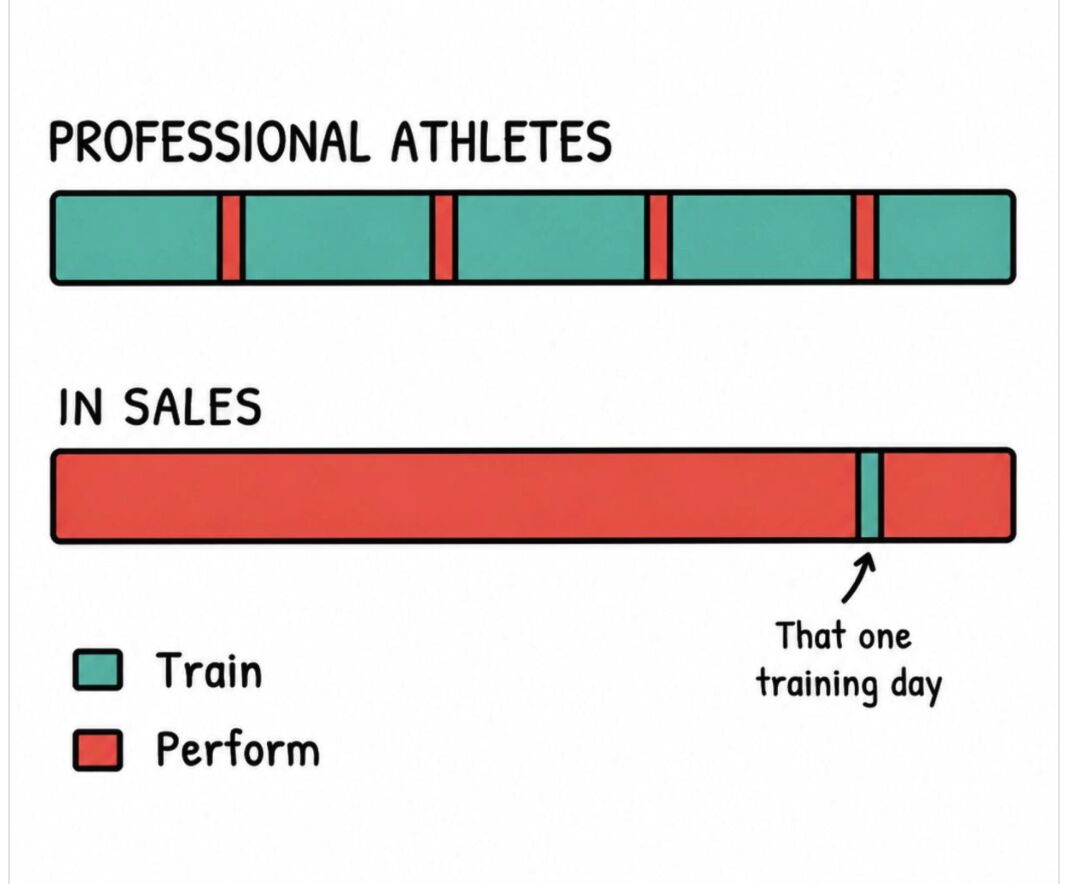
In professional sports, visible performance is merely the result of a much broader effort. Behind every competition, every match, or every decisive moment, there are hours of training, repetition, analysis, recovery, and adjustment.
Athletes don't improve simply by participating in more competitions. They improve because they train methodically. They work on their technique, reinforce their strengths, correct their weaknesses, and develop the necessary reflexes to perform under high pressure.
In sales, this logic is still too rarely applied.
Teams go from one call to the next, one meeting to the next, and one quarter to the next. They must meet their objectives, generate opportunities, close sales, and maintain customer relationships. The pace is demanding, expectations are high, and the time dedicated to continuous improvement is often limited.
However, experience alone is not always enough to create sustainable progress.
Field experience remains essential. It helps develop judgment, confidence, listening skills, and an understanding of customer realities. However, when not accompanied by structured training, it can also lead to a form of stagnation. Teams repeat the same methods, retain certain automatic behaviors, and sometimes continue to use practices that are no longer adapted to market changes.
The best sales teams are those that integrate continuous learning into their operations. They analyze their approaches, test new tactics, improve their qualification, better structure their follow-ups, and use data to make better decisions.
It is precisely within this logic that a RevOps approach makes perfect sense.
RevOps is not limited to implementing dashboards or tracking KPIs. It is a continuous improvement approach that aims to align sales, marketing, customer service, and operations around a common goal: to generate revenue more efficiently, consistently, and predictably.
In this context, CRM becomes a strategic lever.
A CRM like HubSpot should not be perceived as a mere administrative platform. When well-structured, well-integrated, and well-adopted by teams, it allows for centralizing information, standardizing follow-ups, automating certain tasks, improving pipeline visibility, and better understanding which opportunities to prioritize.
However, a CRM does not generate performance on its own. Like a training program, it must be understood, mastered, and used consistently. The value comes not only from the tool but from how teams integrate it into their work habits.
This is where specialized support can make a real difference.
The role of a HubSpot agency or CRM partner is not just about configuring a platform. It also involves guiding teams through adoption, simplifying processes, structuring data, and ensuring the CRM actively supports the company's growth objectives.
The same logic applies to sales methodologies. Approaches like Sandler Training exist precisely because sales is a discipline that develops through practice, coaching, and repetition. Knowing how to ask the right questions, effectively qualify a prospect, handle objections, and create value are skills that must be regularly honed.
This thinking doesn't just apply to sales representatives.
Sales leadership must also embrace a philosophy of continuous improvement. Managers and leaders cannot simply analyze results at the end of the month or quarter. They must also step back and evaluate processes, coach their teams, review the indicators used, and ensure that the tools in place truly support performance.
The most successful organizations are often those where learning is part of the culture. Sales representatives continuously develop their skills, managers play an active coaching role, processes evolve with market needs, and technologies are used as true growth drivers.
In an environment where sales cycles are becoming more complex, customer expectations are rapidly changing, and technologies like CRMs, automation, and artificial intelligence are transforming business practices, this adaptability becomes a significant competitive advantage.
The most successful sales teams are therefore not necessarily those who work the hardest. They are the ones who take the time to better prepare, better equip themselves, and continuously improve.
Like elite athletes, they know that sustainable performance doesn't solely rely on talent or experience.
It relies on training, discipline, repetition, and the ability to constantly progress.