
What is technological architecture and why is it strategic?


What is technological architecture and why is it strategic?
When a company is considering its digital transformation, there is a great temptation to start with the tools. New CRM, new marketing platform, new prospecting tool. However, a coherent technology architecture never starts with the technology itself.
It starts with a clear understanding of the company's vision, growth goals, and most importantly, how it operates on a daily basis. Before choosing or replacing a system, it is essential to understand how the organization generates opportunities, how it sells, how it delivers, and how it maintains customer relationships. The technological architecture aims above all to support these operations and to structure the flow of information that makes them possible.
Understand the Lead-to-Cash process before talking about tools
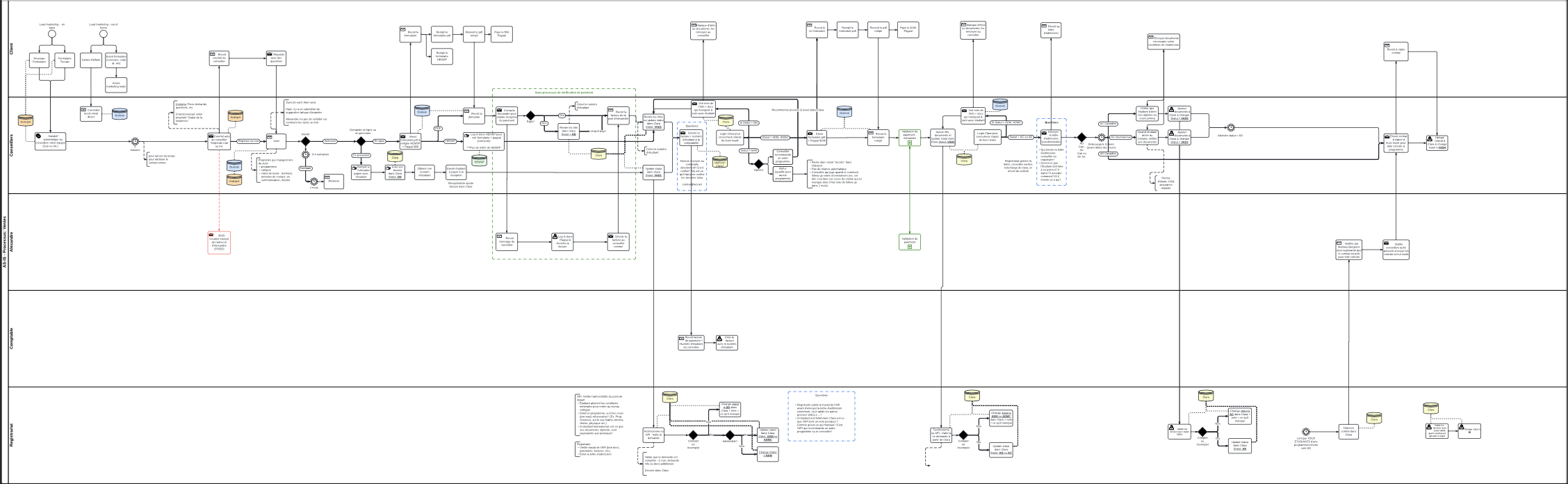
At the heart of any technological architecture is the Lead-to-Cash process. This process represents all the steps that go from the first contact with a prospect to the final sale, including customer follow-up and after-sales service. It is a chain of interrelated activities where each step transforms, uses, and transmits information.
To build an effective technological architecture, you need to be able to answer very concrete questions:
- How does a lead enter the organization?
- When is he qualified by the sales team?
- How is an opportunity created and followed up?
- How are submissions managed?
- What triggers an order or a reminder?
These answers define the actual operational process of the business. It is this process that should guide technological choices, and not the other way around. When misunderstood or poorly formalized, tools quickly become a source of friction rather than performance.
In many organizations, CRM does not exist as a single centralized tool. It is often fragmented between several technologies used by different teams according to their immediate needs.
We often find scenarios where Excel is used to manage contact lists, a separate tool for tracking sales, another platform for email marketing, prospecting solutions, and separate tools for after-sales service. Taken individually, these tools can be effective. The problem comes when they don't communicate with each other. The information then becomes duplicated, incomplete, or out of sync. This makes it difficult to track opportunities, increases uncertainty in operations, and limits the ability of teams to work effectively.
CRM as a cornerstone of revenue operations
In a well-thought-out technology architecture, CRM plays a central role in revenue transactions. It becomes the point of convergence for customer data, interactions, interactions, opportunities, and activities related to sales, marketing, and after-sales service.
Platforms like HubSpot make it possible to bring together several essential functions in one place, including contact and business management, sales pipelines, marketing campaigns, and after-sales service tracking. This centralization improves the consistency of information and facilitates collaboration between teams.
Rather than multiplying isolated systems, the objective is to structure the ecosystem around a common data source, while maintaining the flexibility to integrate specialized tools when relevant. The CRM then acts as an anchor, capable of supporting daily operations while offering clear visibility on performance.
Technological architecture: seeing clearly to better decide
Technology architecture is the ability to understand this entire ecosystem, visualize how systems interact with each other, and ensure that they actually support business processes. It makes it possible to link activities, information and technologies in a coherent way.
This understanding often involves technological mapping. This exercise makes it possible to draw up a clear portrait of what exists, to highlight duplications, communication breakdowns and current limitations, and then to identify concrete ways to optimize.
It is from this overall vision that it becomes possible to build a scalable technological architecture, aligned with business objectives and truly at the service of growth, by improving both the effectiveness and efficiency of processes.
In conclusion,
A well-designed technological architecture is not based on the accumulation of tools, but on a detailed understanding of business processes and how information flows within the organization. By placing the Lead-to-Cash process at the heart of thinking and relying on a CRM as a central point, companies are giving themselves the means to structure their operations, improve the quality of their data and support collaboration between teams.
Indeed, in a B2B context, where sales cycles are complex and interactions are multiple, this approach makes it possible to gain clarity, efficiency and agility. Technological architecture then becomes a real strategic lever, capable of supporting growth and evolving at the pace of business needs.
.jpeg)