
Salesforce to HubSpot migration: simplifying your CRM


Salesforce to HubSpot migration: simplifying your CRM
Salesforce, a pioneer in cloud CRM, remains one of the best known and most established systems in the world. Recognized for its robustness and its vast functional coverage, it is however also perceived as one of the most expensive and complex solutions to operate.
A little bit of context: yes, Salesforce paved the way in the world of CRM, but it is now nicknamed the “Frankenstein of CRMs”. Why? Because its growth strategy has largely been based on successive acquisitions, adding specific technologies to its ecosystem without always ensuring a smooth or native integration between them. The result: more friction, additional costs and complexity that is often underestimated at the beginning.
That said, Salesforce is still a powerful technology that can support the growth of businesses of all sizes. However, for several SMEs and large organizations, this solution is not always the most adapted to their reality: need for agility, simplicity, realistic implementation costs, while maintaining the possibility of customizing and exploiting artificial intelligence.
This is where HubSpot CRM comes in. The platform is increasingly becoming a modern, scalable and intuitive alternative. HubSpot also makes acquisitions, but unlike Salesforce, each technology acquired is rebuilt and integrated natively into its own environment. This approach ensures a smooth user experience, a consistent interface (UI/UX) and consistent performance across all of its Hubs.
For these reasons, we are now seeing a growing wave of migrations from Salesforce to HubSpot. Businesses are finding it a solution that is less expensive, more flexible, faster to adopt, and continuously enriched by AI-powered features.
Why complicate your life when you can simplify it?
Example of a Salesforce to HubSpot migration project
Take the example of a Canadian manufacturing company working in the creative and entertainment sector. It has approximately 120 employees and generates an annual turnover of 50 to 75 million dollars.
The organization had been using Salesforce CRM for several years, along with the Pardot marketing automation module. On a technical level, nothing seemed to be working: the marketing campaigns were running well, and the lead scoring was precisely configured.
However, several irritants were hampering overall performance:
- the total cost of the platform had become difficult to justify;
- the adoption rate of CRM by the sales team remained low;
- and above all, there was no smooth integration between Salesforce and the company's ERP system.
The management team therefore set a clear objective: to reduce the overall cost of CRM (including Salesforce and Pardot licenses), simplify processes, and maintain key functionalities that already supported marketing performance and sales, including:
- marketing automation and multi-channel campaigns;
- lead scoring and follow-up of prospects;
- the management of trade show campaigns and nurturing sequences;
- the visualization of a clear and intuitive sales pipeline;
- automating tasks in the pipeline (assignments, reminders, notifications);
- a bi-directional CRM—ERP integration, allowing you to trigger the creation of quotes and quotes from HubSpot to the integrated CPQ;
- and real-time dashboards for monthly, quarterly, and annual sales forecasts.
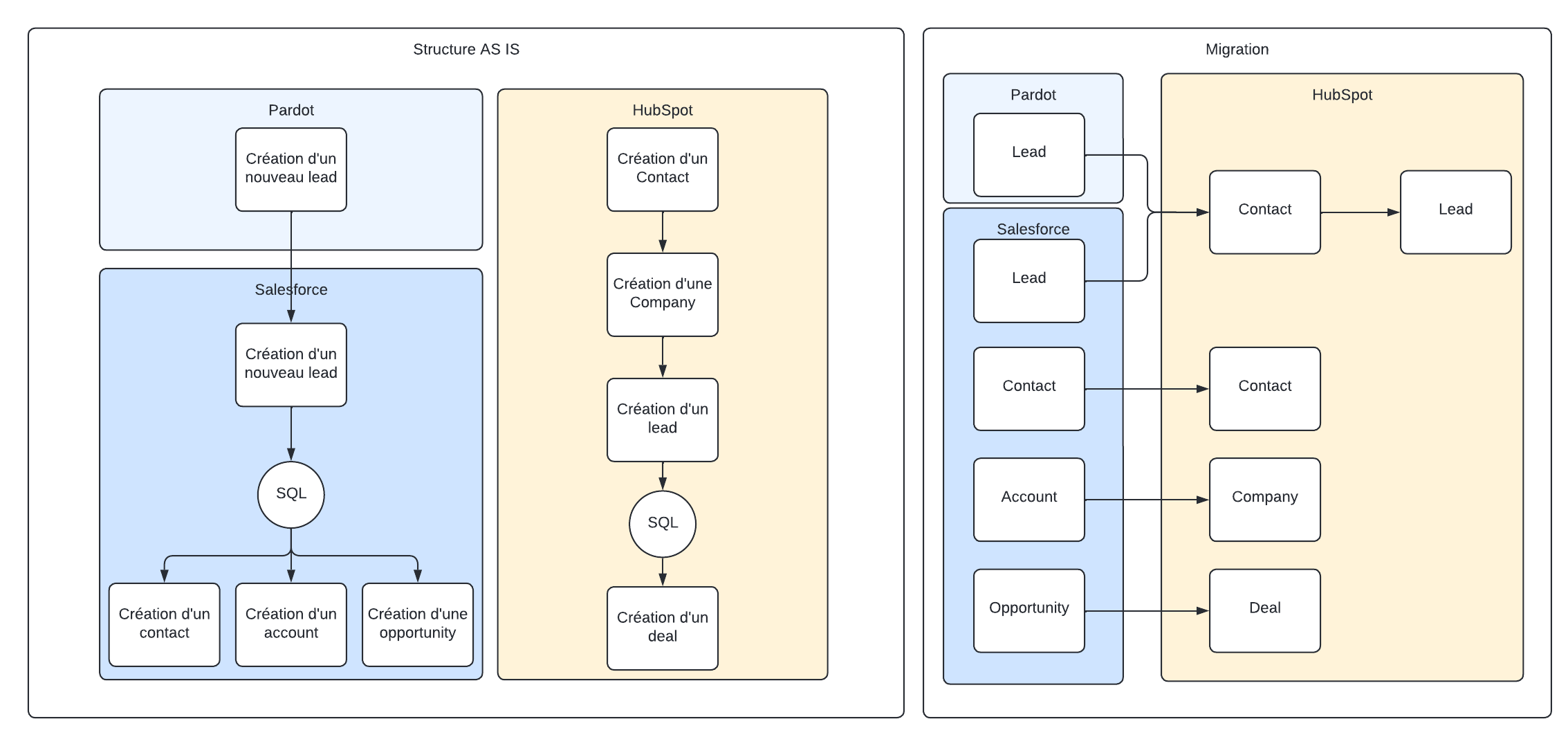
Understanding the structural difference: Salesforce vs HubSpot
One of the key elements of this migration was the fundamental difference between the two platforms.
HubSpot is based on a unified model, centered on Contact, which becomes the single source of truth. As soon as a person interacts with the company — whether via a form, a marketing campaign or a call, a Contact is created. This same registration accompanies the prospect throughout their cycle: marketing qualification, qualification through sales, then opportunity. No duplication of objects, no breaks between departments. It's all connected, up to date, and consistent.
Conversely, in the Salesforce + Pardot ecosystem, a prospect's journey is based on two distinct systems, each with its own logic. Pardot manages lead generation and nurturing. When a lead becomes “marketing qualified,” a new record is created in Salesforce. Then, once qualified by sales, this lead is converted into three distinct objects: a Contact, an Account, and an Opportunity.
This structure, while powerful, often creates redundancies and makes it difficult to synchronize data between marketing and sales.
During the migration, this difference in structure had a direct impact on the transfer strategy.
As HubSpot does not allow you to create a lead without a parent Contact, it was first necessary to rebuild the Contacts database, before recreating the other objects around this foundation.
All of the data preparation work has been focused on one goal: sanitizing and reorganizing Salesforce records to ensure a clean, consistent database that is fully aligned with the HubSpot data model.
A successful migration thanks to a structured and optimized approach
The success of this project is not based solely on the technical transfer of data from Salesforce to HubSpot. It has mainly been played out in the restructuring of RevOps processes.
Even before importing any contact, the Lakhos team supported the company in mapping its CRM processes, analyzing its needs and prioritizing the automations to be implemented.
This approach made it possible to optimize each stage of the customer journey, from lead generation to submission, while promoting rapid adoption by the sales team.
Concrete results:
- 45% reduction in annual licensing costs related to CRM;
- adoption rate of over 90% among representatives;
- better visibility on forecasts and marketing-sales performance.
Migrating from Salesforce to HubSpot is not just about changing tools. It’s about rethinking how your teams work and how you manage customer relationships. Organizations that make this move want to simplify their day to day, reduce costs, and give their teams a CRM that actually supports them.
The example above makes it clear. When a migration is well planned, supported by a solid RevOps approach and strong data preparation, it becomes possible to transform a heavy and complex platform into a simple, coherent system that teams actually adopt.
HubSpot isn’t just an alternative to Salesforce. For many companies, it has become the most logical choice. Simpler. More intuitive. Better integrated. And above all, built around a clear and unified view of the customer.

.jpeg)