
Why process mapping is a key step before a CRM implementation project


Why process mapping is a key step before a CRM implementation project
In any technological implementation process, whether it is a CRM, an ERP or CRM and ERP integrations, it is essential to take a step back before talking about tools. Too often, organizations want to move quickly to the solution without clearly defining their sales processes and business priorities.
At Lakhos, we see it on the ground: successful projects are those that start with rigorous CRM analysis and lead-to-cash process mapping.
Before technology: aligning internally
Before even starting a CRM implementation project, there are a few critical steps that should not be skipped.
1. Aligning leadership with vision
A CRM project is not an IT project. It's a business project.
The direction should be aligned with:
- the vision,
- the goals,
- priorities,
- and the level of effort required.
Without this alignment, even the best HubSpot CRM won't deliver the expected results.
2. Identify internal champions
Each project needs motivated people internally:
- sales managers,
- representatives,
- marketing,
- operations.
These champions become the relays between the HubSpot Agency/HubSpot Partner and the internal teams.
3. Asking the right questions
Before talking about automation or integrations, you need to clarify the goals:
- Do we want to increase revenue?
- Increase sales volume?
- Be more effective in following up on submissions?
- Reduce lost opportunities due to lack of stimulus?
- Better structure prospecting or trade show initiatives.
These answers will directly influence the configuration of the CRM and the RevOps logic.
Understand the current state before trying to improve it
Once the objectives are clear, we go down one level: how the company operates today.
Be able to clearly answer questions such as:
- How does a lead enter the organization?
- How is he qualified?
- When does it become an opportunity?
- How are submissions created?
- What triggers an order?
If these answers are unclear, it's a clear signal that process mapping work is needed.
Lead-to-cash process mapping: what exactly is it?
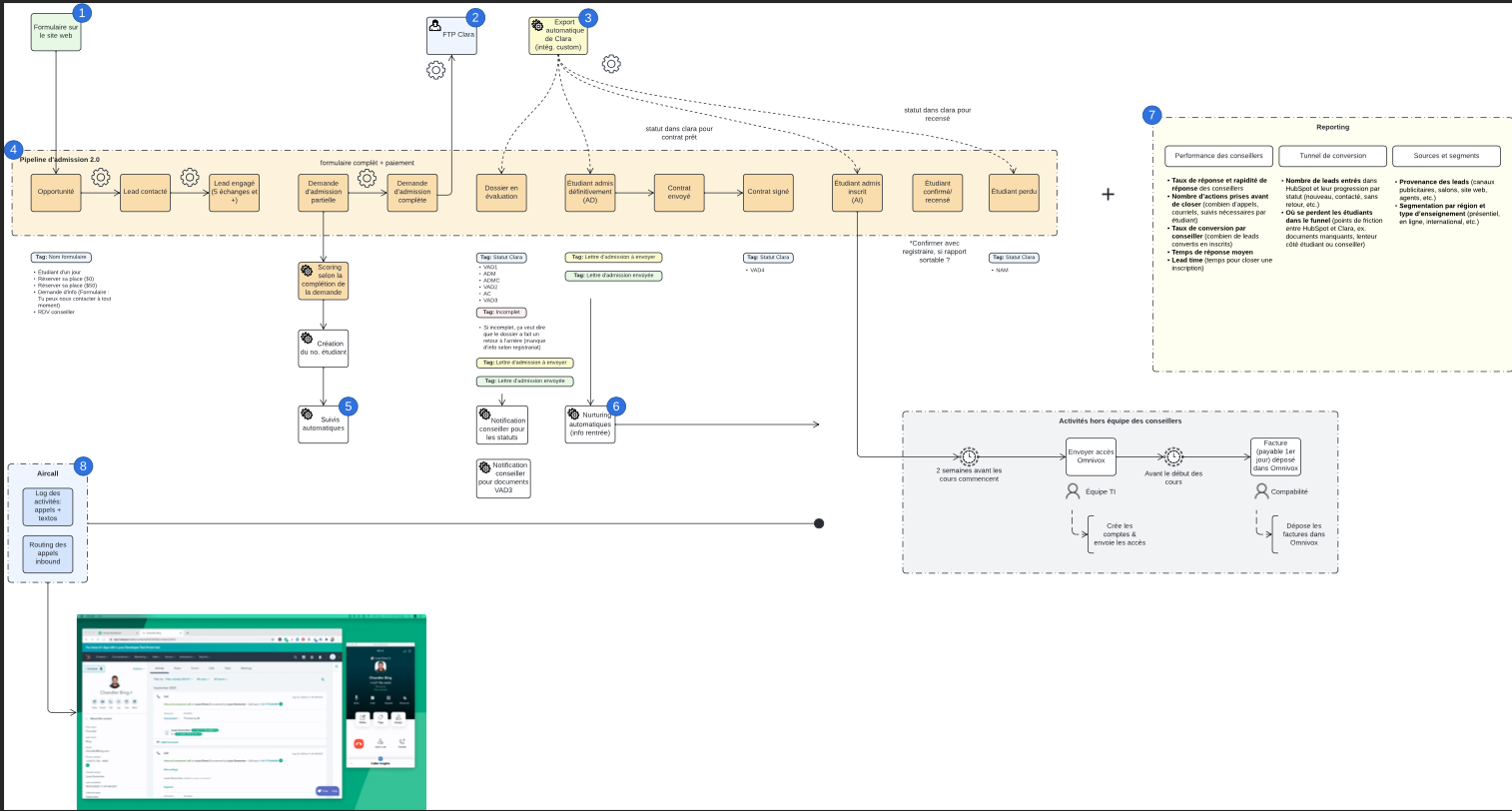
Lead-to-cash process mapping consists in documenting, in a visual and structured way, all the steps that lead from the first contact (lead) to the sale concluded and collected (cash).
This generally includes:
- lead generation and qualification,
- prospecting (including trade shows),
- opportunity management,
- creating submissions,
- internal approval,
- order,
- post-sale follow-up.
The aim is not to reinvent everything, but to:
- understand what is already working well,
- identify irritants,
- prepare intelligent digitization in the CRM.
BPMN method: a simple way to structure processes
The Business Process Model and Notation (BPMN) method is a standard used to visually represent business processes.
Concretely, we use:
- clear steps,
- decisions (yes/no),
- roles (sales, marketing, operations),
- and logical flows.
The advantage of BPMN is that it is:
- understandable by business teams,
- structured enough to guide CRM implementation,
- ideal for documenting a future target process.
Concrete example: manufacturing company with 50 employees
Let's take a manufacturing company with 50 employees, with:
- standard products (SKU),
- tailor-made projects (custom),
- a field sales team,
- participation in trade shows.
Current situation (before mapping)
- Trade show leads are entered in Excel.
- Some representatives qualify quickly, others do not.
- Submissions are made in a separate tool.
- Little structured follow-up after submissions are sent.
- Lost opportunities are not analyzed.
Contribution of process mapping
Mapping makes it possible to clearly define:
- When a lead becomes MQL then SQL
- What criteria qualify a custom vs SKU project
- How an opportunity is created in HubSpot
- Who is involved at each stage
- When should a submission be relaunched
- When an opportunity becomes an order
The result: a clear, aligned process, ready to be set up in a CRM like HubSpot.
From mapping to CRM project plan
A good mapping then makes it possible to develop a realistic CRM implementation project plan, for example:
- CRM analysis and process validation
- HubSpot Data Model Definition
- Sales pipeline setup
- Automations (reminders, tasks, notifications)
- CRM and ERP integrations if required
- Team training
- Testing and adjustment phase
The Lakhos approach
At Lakhos, as a HubSpot Partner, we help industrial and manufacturing companies to:
- precisely map their Lead-to-Cash processes,
- structure their RevOps approach,
- build a realistic project plan,
- and implement a HubSpot CRM aligned with the reality on the ground.
Our aim is not to implement a tool, but to create a system that really supports growth.
.jpeg)